What is
Revenue Stamped Paper?
Civil War-Era Tax Stamps on Bank Checks and Other Financial Documents
In 1862, at the onset of the Civil War, the government levied taxes on nearly everything you can think of to raise funds for the Union cause. In crafting the tax laws, Congress considered everything from feathers to locomotive parts as targets for taxation.
Then there were the documentary taxes — taxes levied on legal agreements and financial instruments including bank checks, mortgages, stocks, and bonds. At first, these taxes were paid by purchasing adhesive revenue stamps and affixing them to the documents. Then, as required by law, the stamps had to be canceled by initialing and dating them. For bank checks, the tax was 2¢ per check. So for every check written, a 2¢ revenue stamp had to be acquired, applied, and canceled.
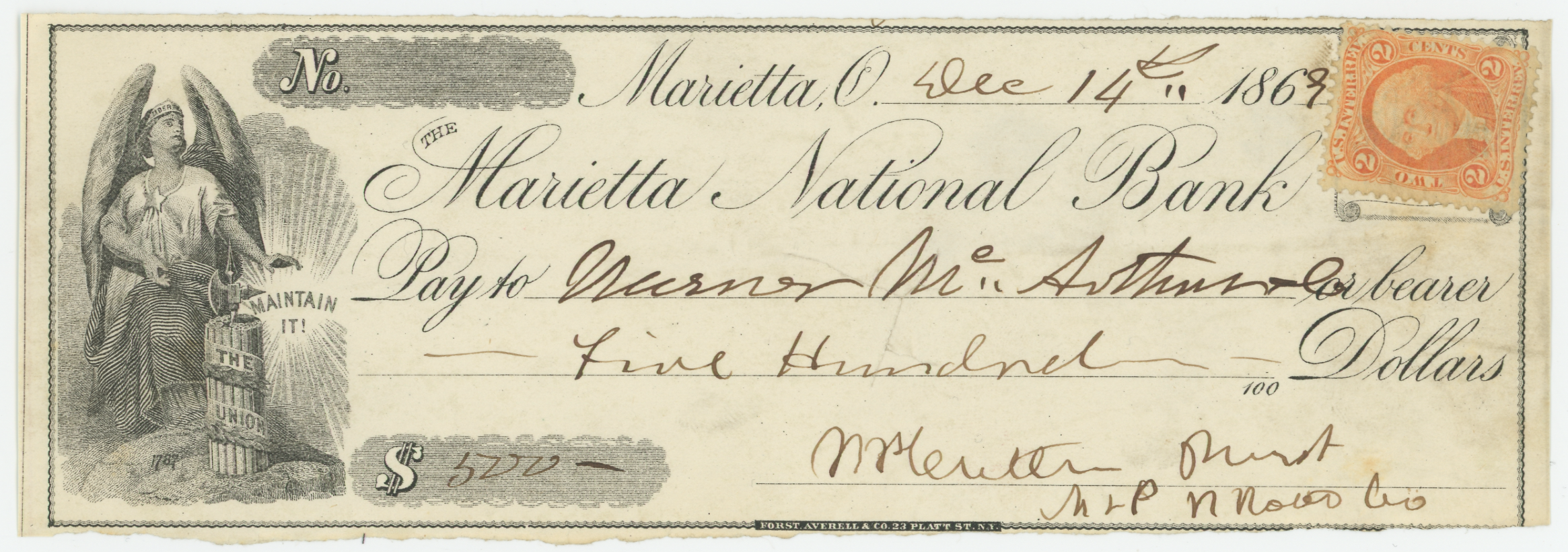
Interestingly enough, the 2¢ revenue stamp on this check was never canceled! In the eyes of the law this was illegal. But enforcement was lax, hence it is not unusual to find examples like this one.
Imprinted Revenue Stamps
In June 1865, the Commissioner of Internal Revenue authorized imprinting of revenue stamps directly onto financial documents. This didn’t replace the use of adhesives, it was simply an option. The full range of imprinted revenue stamps are listed in the Scott Catalog under the heading of Revenue Stamped Paper (prefix RN).
For businesses writing a large number of checks, having each one pre-printed with a stamp was a quite a time-saving convenience. Checking account holders could order checkbooks or ledgers with the stamps printed on the paper, hence the term “Revenue Stamped Paper”. The orange imprint in the center of this check is a 2¢ Type B revenue stamp (Scott RN-B1, unused).
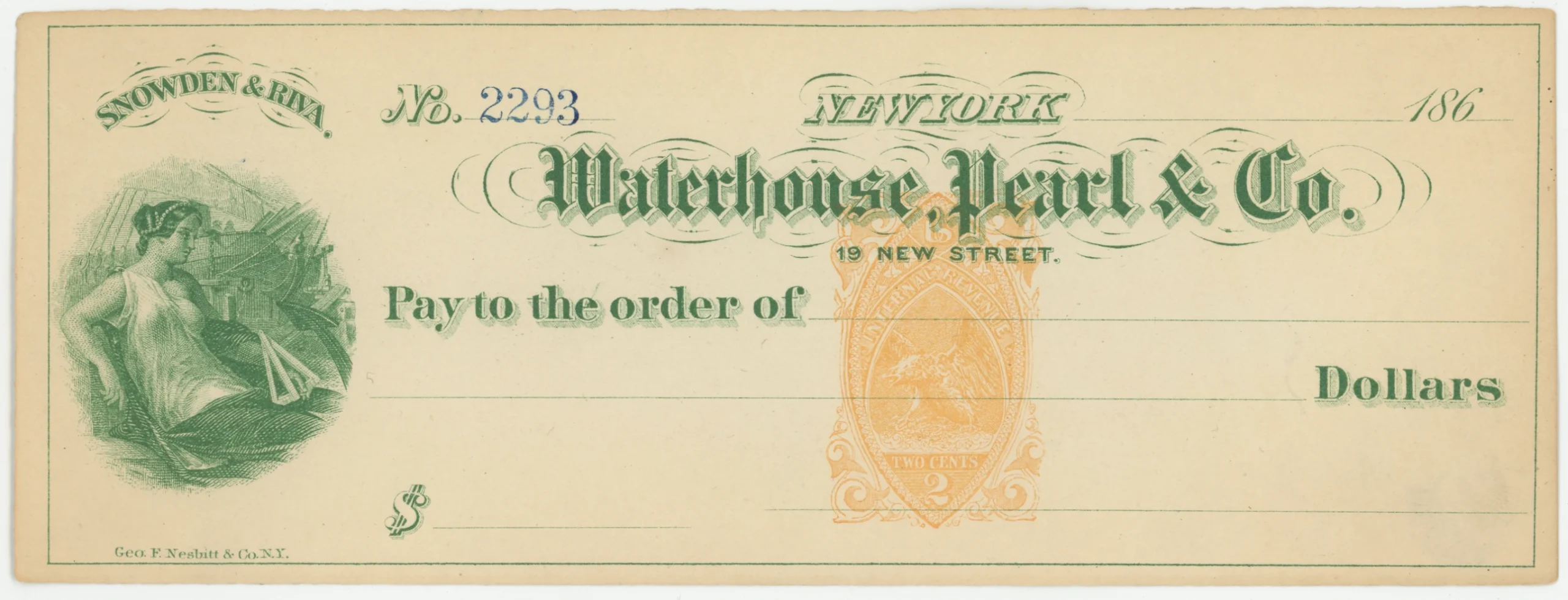
Filling out the check served the same purpose as initialing and dating the stamp to cancel it, even if the handwriting didn’t touch the stamp as in the next example (Scott RN-B3). This is because the Commissioner declared that “the entire instrument is the stamp.” He also ruled that imprinted stamps couldn’t be cut from one instrument and used on another. To do so rendered the stamp invalid.
Imprinted revenues could also be printed on receipts, stocks, bonds, insurance policies, even train tickets such as this parlor car ticket which was taxed 1¢ (Scott RN-X5a).

Types
There are 24 basic imprinted stamps designs called Types designated with the letters A through X. Each Type is simply a new issue of stamp, just like new issues of postage and revenue stamps changed in style and form over time.
Catalog numbers for imprinted revenues start with the prefix RN followed by a letter for the Type. Then comes a number, or number & letter combination, indicating color or subtype. For example, the orange Type B stamp shown above is RN-B1, where 1 is for orange. The blue stamp is also a Type B, RN-B3 where 3 is for blue. Look closely and you’ll see that they’re the same stamp design, just different colors.
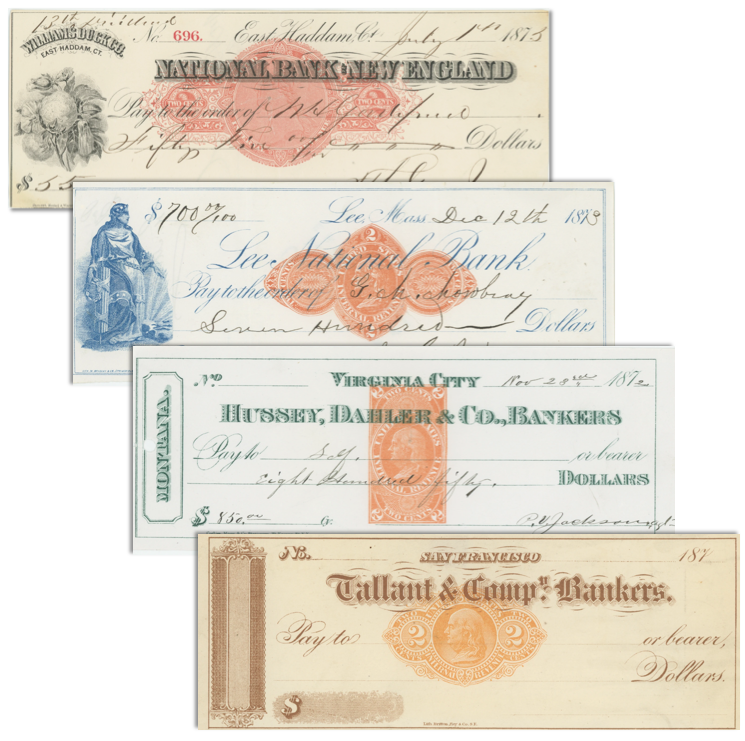
This next image shows a variety of bank checks with RN Types C, D, E, and F. Our extensive inventory of bank checks includes check designs ranging plain to ornate, used and unused.
A great approach to collecting revenue stamped paper is to form a Type Collection focusing solely on bank checks, drafts, and receipts. Such a collection will focus only on 16 of the 24 basic imprints types, Types A through O and just one of the Type X variants, RN-X7. Those are all 2¢ denominations. The other Types, P, Q, R, S, T, U, V, and W are all higher denomination imprints used on certificates of deposit, stocks, and bonds.
Your Collection, Your Way!
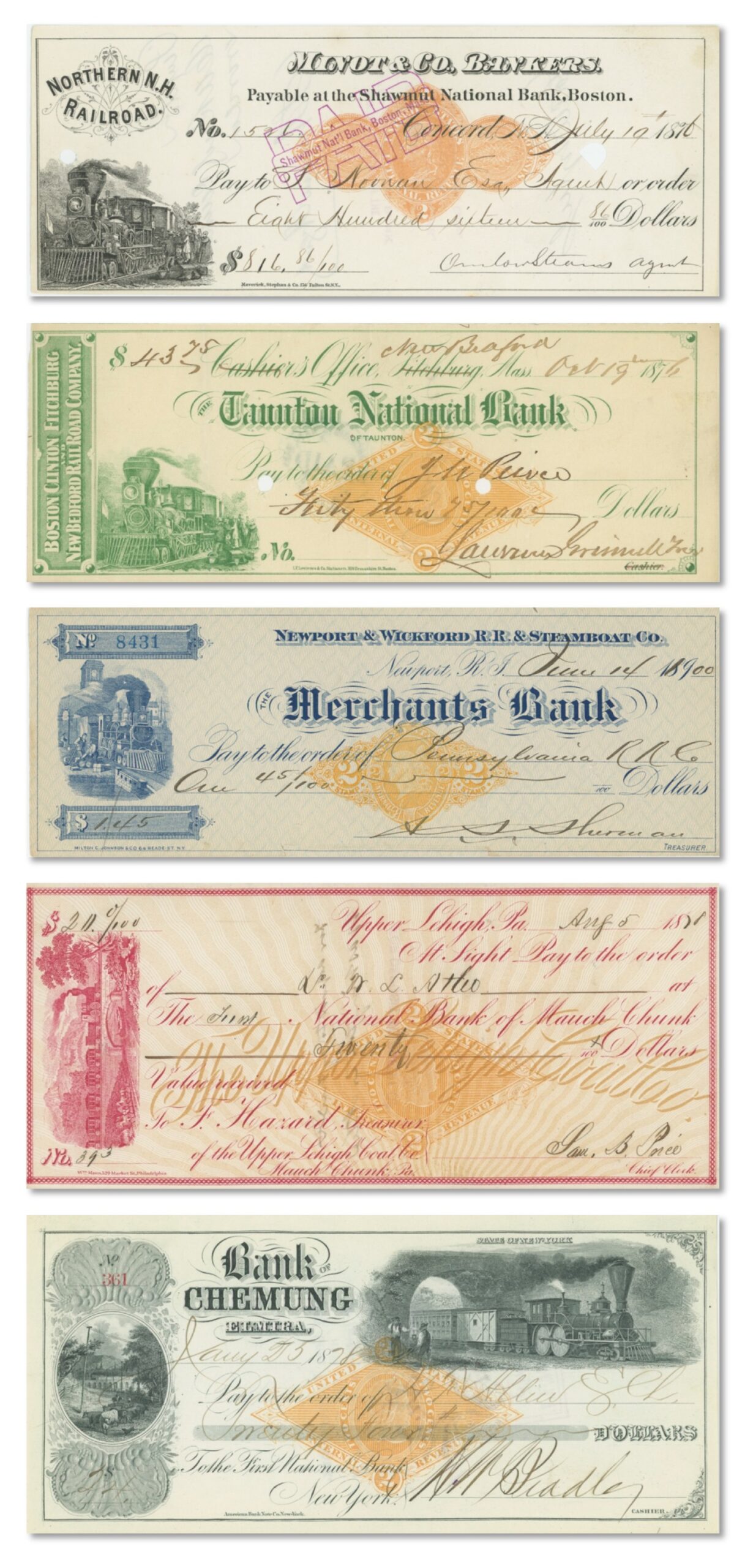
While forming a Type Collection with checks makes a great foundational approach to collecting revenue stamped paper, keep in mind that in this field there are no rules. You can collect checks by State, City, vignette (nautical, agricultural, railroads, etc.), business or industry, or however you see fit. Below is a topical grouping of checks with railroading vignettes issued from banks in various states, featuring 3 different imprint Types. Click Here to find locomotive and railroad-vignetted checks in our inventory.
Remember, this is still stamp collecting but with a great deal of added interest!